
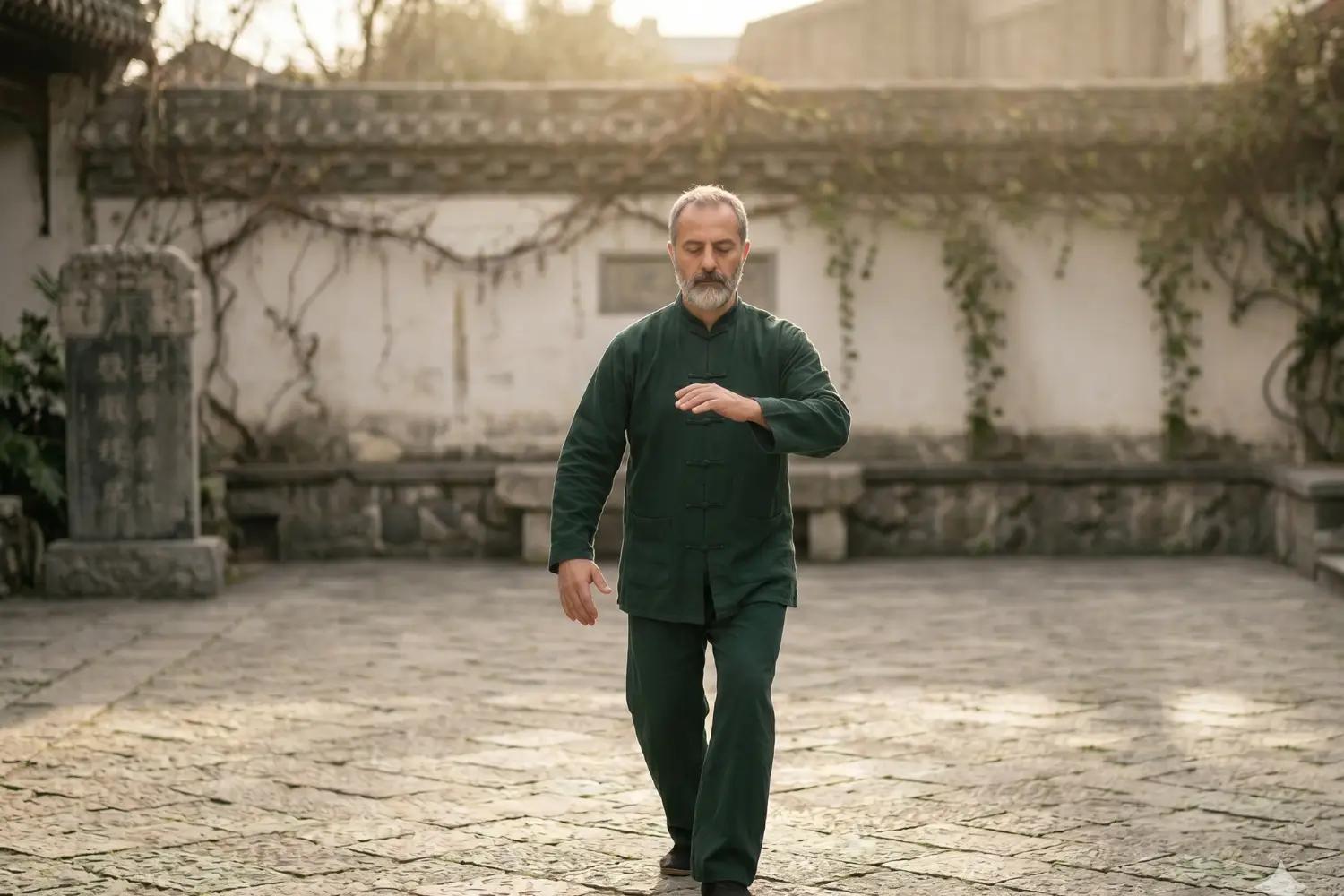
We live in an age of constant overstimulation. We are swamped by notifications, deadlines and noise, and as a result our body stays on permanent alert. Unfortunately, chronic stress silently wears the body down.
In this context, the benefits of Tai Chi for the nervous system offer a remarkable solution. This ancient discipline fits perfectly with what modern neurophysiology tells us, and through it we can rediscover a genuine sense of calm.
The autonomic nervous system: balancing fight-or-flight and rest
The autonomic nervous system has two main branches. On one side is the sympathetic system, which handles emergencies. On the other is the parasympathetic system, responsible for rest.
Modern life overactivates the sympathetic system. Tai Chi practice, by contrast, directly stimulates the parasympathetic system. Its movements are fluid, slow and continuous, so the heart rate quickly settles and cortisol levels drop.
The vagus nerve and the bioenergetics of the internal arts
Traditional Chinese medicine speaks of the free flow of Qi and seeks balance between Yin and Yang. Western science finds a parallel to these ideas in the vagus nerve, which governs the relaxation response.
The movements of Tai Chi and Qi Gong engage the spine and activate deep diaphragmatic breathing. This mechanically stimulates the vagus nerve. It is not a matter of suggestion: it is a precise physiological response.
Proprioception and interoception: inhabiting the body to calm the mind
The human mind tends to ruminate on the past and often projects its anxieties onto the future. Fortunately, Tai Chi breaks this endless loop by shifting attention to the inner senses: proprioception and interoception.
During the form you need to stay aware of how your feet meet the ground and how your weight shifts. This total presence fills the channels of attention, so anxious thoughts fade away and the brain finally gets some rest.
Neuroplasticity: reshaping the stress response through consistency
The brain is not fixed: it shapes itself according to our habits. If we always react with anxiety, we strengthen that neural circuit.
Regular Tai Chi practice introduces a new pattern instead. We learn to move while keeping inner calm, and the nervous system learns not to react on impulse. Over time, we develop deep resilience.
The importance of in-person guidance and correction
The internal complexity of Tai Chi is considerable, and a self-taught practitioner cannot grasp it alone. Movements are often imitated only superficially while hidden tension remains in the neck, and the therapeutic effect is lost.
That is why personalised teaching matters. A qualified instructor notices every micro-tension and guides the student towards real integration, making the practice safe.
Practising Tai Chi and Qi Gong in Naples: what Chu Xin offers
For all these reasons, the Chu Xin school in Naples is an oasis of authenticity and the ideal place to find your centre again. Its teachers faithfully follow the tradition.
The school offers regular classes and in-depth Tai Chi seminars, so you can relieve the stress of city life in a concrete way. If you are looking for a Tai Chi or Qi Gong course in Naples, this is the place. Choosing Chu Xin means cultivating your own health.