
Philosophical roots
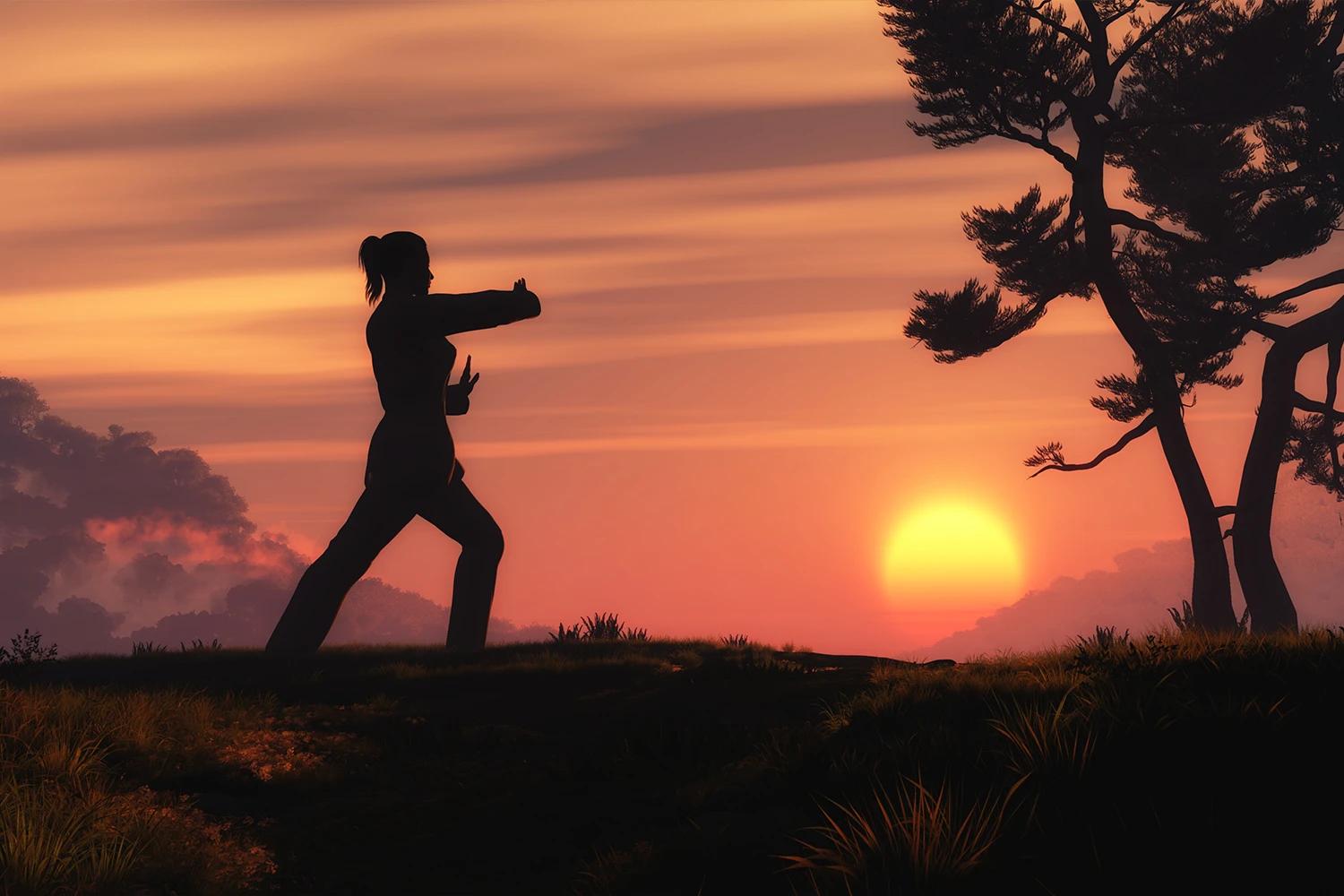
Taiji Quan is a martial art and a meditation in motion, with origins in ancient Chinese thought, particularly Taoism.
- Taiji (太極) means “Supreme Ultimate” or “Great Polarity” and is represented by the Taijitu symbol (the circle with Yin and Yang).
- The basic idea is that the universe and life are governed by the harmonious movement of two opposing yet complementary forces: Yin (receptive, soft, inner) and Yang (active, hard, outer).
Taiji Quan was therefore born as a practice to harmonise body, mind and energy (Qi), setting these cosmic principles in motion within the human body.
Legendary origins
According to legend, the founder of Taiji Quan was Zhang Sanfeng, a Taoist monk of Mount Wudang who lived between the 13th and 14th centuries. It is said that, watching a fight between a crane and a snake, Zhang grasped a way of fighting based not on brute force but on adaptability, softness and the use of internal energy. From there he is said to have developed the system that later became Taiji Quan.
Documented historical origins
Historically, Taiji Quan developed in the 17th century, notably within the Chen family in the village of Chenjiagou (Henan province).
- Chen Wangting (1600–1680), a retired military officer, codified the first forms of Taiji Quan, integrating:
- existing martial techniques,
- Yin-Yang theory,
- Taoist breathing and energy cultivation exercises.
Later, members of the Chen family taught Taiji Quan outside the family, giving rise to various styles. The most famous of their students was Yang Luchan (1799–1872), founder of the Yang style, today the most widely practised in the world.
From China to the world
Over time, several main styles developed from the original Chen core:
- Chen (more martial, with explosive movements),
- Yang (broader, flowing, meditative),
- Wu, Sun and others.
Today Taiji Quan is practised all over the world not only as an internal martial art but also as a health practice and meditation in motion, recognised by modern medicine for its benefits on stress, balance, joints and the nervous system.
In conclusion
Taiji Quan was born from the union of martial art, Taoist philosophy and energy practice. From legend (Zhang Sanfeng) to historical reality (Chen Wangting), it has become a way of cultivating inner strength, harmony and balance, adaptable to many levels: from self-defence to health and spirituality.