
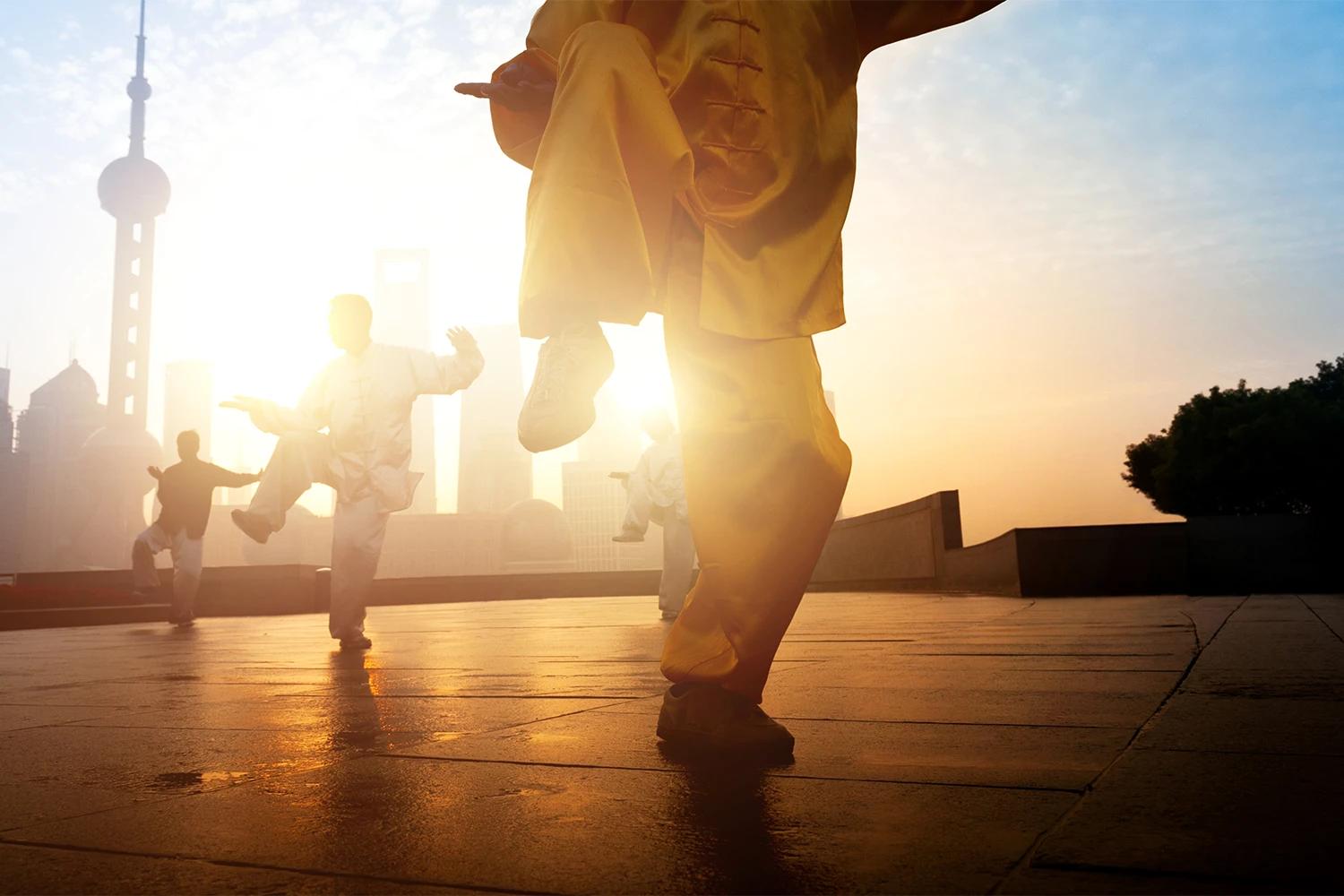
Taiji Quan (or Tai Chi Chuan) is an internal martial art from China that richly unites movement, breathing and awareness. Today it is known all over the world as a wellness practice, a meditation in motion and a martial discipline, but its roots are ancient and tied to a tradition that has developed into several styles, each with its own distinctive features.
There are five main recognised styles: Chen, Yang, Wu, Wu/Hao and Sun. All derive from the Chen style, considered the original form, but over time masters adapted and simplified the practice, creating variants that meet different needs.
The differences between the main styles
- Chen style (陳氏太極拳): The oldest, born in the village of Chenjiagou in the 17th century. It is characterised by alternating softness and explosive power (fa jin), low stances and energetic spirals. It includes strongly martial elements, such as fast strikes, jumps and twists.
- Yang style (楊氏太極拳): Created in the 19th century by Yang Luchan, it is now the most widespread style in the world. Its movements are broad, soft and continuous, accessible to people of all ages. The Yang style made Taiji popular as a health practice rather than a martial one.
- Wu style (吳氏太極拳): Introduced by Wu Jianquan, it stands out for its more inclined postures and subtle energy work. It is much appreciated by those seeking a refined practice centred on inner balance and fluidity.
- Wu/Hao style (武氏太極拳): Rarer, it is known for its precision and small, compact, slow movements. It is highly technical and requires great inner concentration.
- Sun style (孫氏太極拳): Created by Sun Lutang, a master of the internal arts, it incorporates elements of Xing Yi and Bagua. It is characterised by agile steps, quick movements and openings and closings that make it dynamic and lively.
The Chen style: the heart of the tradition
The Chen style is the origin of Taiji Quan. Founded by Chen Wangting, a retired Ming dynasty general, it combines martial principles with Taoist philosophy, breathing and Traditional Chinese Medicine.
Features of the Chen style:
- Spiral movements: every gesture follows a principle of circularity and spiralling (chansi jin, “silk-reeling force”).
- Alternation of Yin and Yang: slow, soft movements give way to sudden bursts of power (fa jin).
- Low, solid stances: these require strong legs and a stable centre of gravity.
- Martial integration: the Chen style preserves strikes, throws and joint locks, revealing its original nature as a fighting art.
The benefits of the practice
Although more demanding than other styles, the Chen style offers enormous benefits:
- it strengthens muscles and joints;
- it improves balance and coordination;
- it develops deep bodily and energetic awareness;
- it combines meditation and physical training in a single practice.
The Chen style today
In the schools that teach it, the Chen style is offered both in its traditional form (more martial and intense) and in adapted versions, accessible to those who want to practise for wellbeing without necessarily tackling the more dynamic aspects.
It is a style that takes us back to the origins of Taiji Quan, keeping its martial power and philosophical richness intact. For those who practise it, it becomes a true path of personal transformation, where strength and softness merge in a unique harmony.
The Chen style is the root from which all of Taiji Quan developed. Practising it means connecting with the most authentic tradition and discovering an art that is not just movement, but a path of awareness, balance and life.