
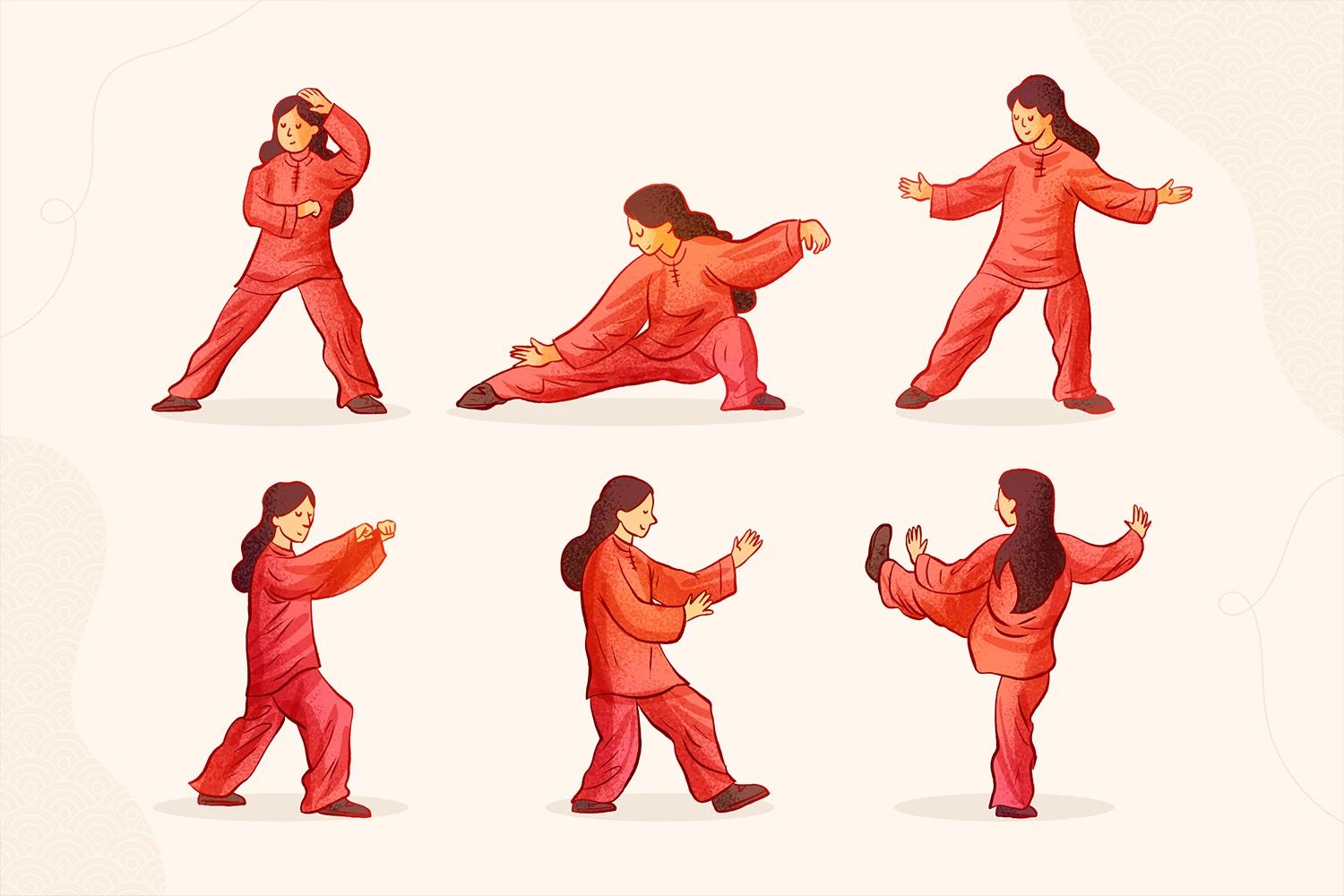
Qi Gong is an ancient Chinese discipline that unites movement, breathing and awareness. At the heart of its practice is a series of fundamental postures, which can be static or dynamic. Each of them aims to encourage the flow of Qi (vital energy), improve posture, strengthen the body and calm the mind.
1. Wu Ji (the posture of original stillness)
This is the starting and finishing position of many Qi Gong exercises.
- Features: feet parallel and slightly apart, knees soft, arms relaxed by the sides, spine aligned, chin slightly tucked.
- Benefits: rootedness, centring and preparation for movement. It is a posture that teaches presence and the return to the “original emptiness”.
2. Zhan Zhuang (standing like a post)
Also called “tree posture”, it is one of the most powerful static practices.
- Features: the arms are raised in front of the body, as if hugging a large tree; the feet are rooted in the ground, the back straight, the breathing deep.
- Benefits: it develops internal strength, endurance and mental stability, and enhances the flow of energy along the meridians.
3. Ma Bu (horse stance)
Another grounding posture, also widely used in the martial arts.
- Features: legs wider than shoulder-width apart, knees bent, pelvis lowered, spine upright. The hands may rest on the hips, in front of the chest or in other mudras.
- Benefits: it strengthens the legs and pelvis, stabilises the centre of gravity and activates Qi in the lower Dantian (energy centre).
4. Tui Bu (forward step)
- Features: one foot steps forward, the other stays behind with the heel rooted; weight is distributed but mostly on the front leg.
- Benefits: it develops balance and mobility and prepares for the flow of dynamic movements.
5. Gong Bu (bow stance)
- Features: front leg bent at 90°, back leg extended, feet firmly on the ground, body projected forward.
- Benefits: it strengthens the legs, improves circulation and stimulates energy in the lower body.
6. Xu Bu (empty step)
- Features: the weight is mostly on the back leg, while the front foot lightly touches the ground with its toes.
- Benefits: it cultivates lightness, agility and sensitivity to movement.
7. Seated and lying postures
Qi Gong is not limited to standing: there are seated and lying practices that encourage deep relaxation.
- Seated: cross-legged or on a chair, with attention to the breath and the flow of energy along the spine.
- Lying down: practices that combine breathing, visualisation and the release of tension, helping to rebalance the nervous system.
Conclusion
The postures of Qi Gong are not mere positions of the body but gateways to wellbeing and vitality. They teach us to root ourselves like a tree, to move with lightness and to listen to the flow of energy within and around us. Each posture is a silent dialogue between body, mind and spirit, and together they form a path of deep harmonisation.