
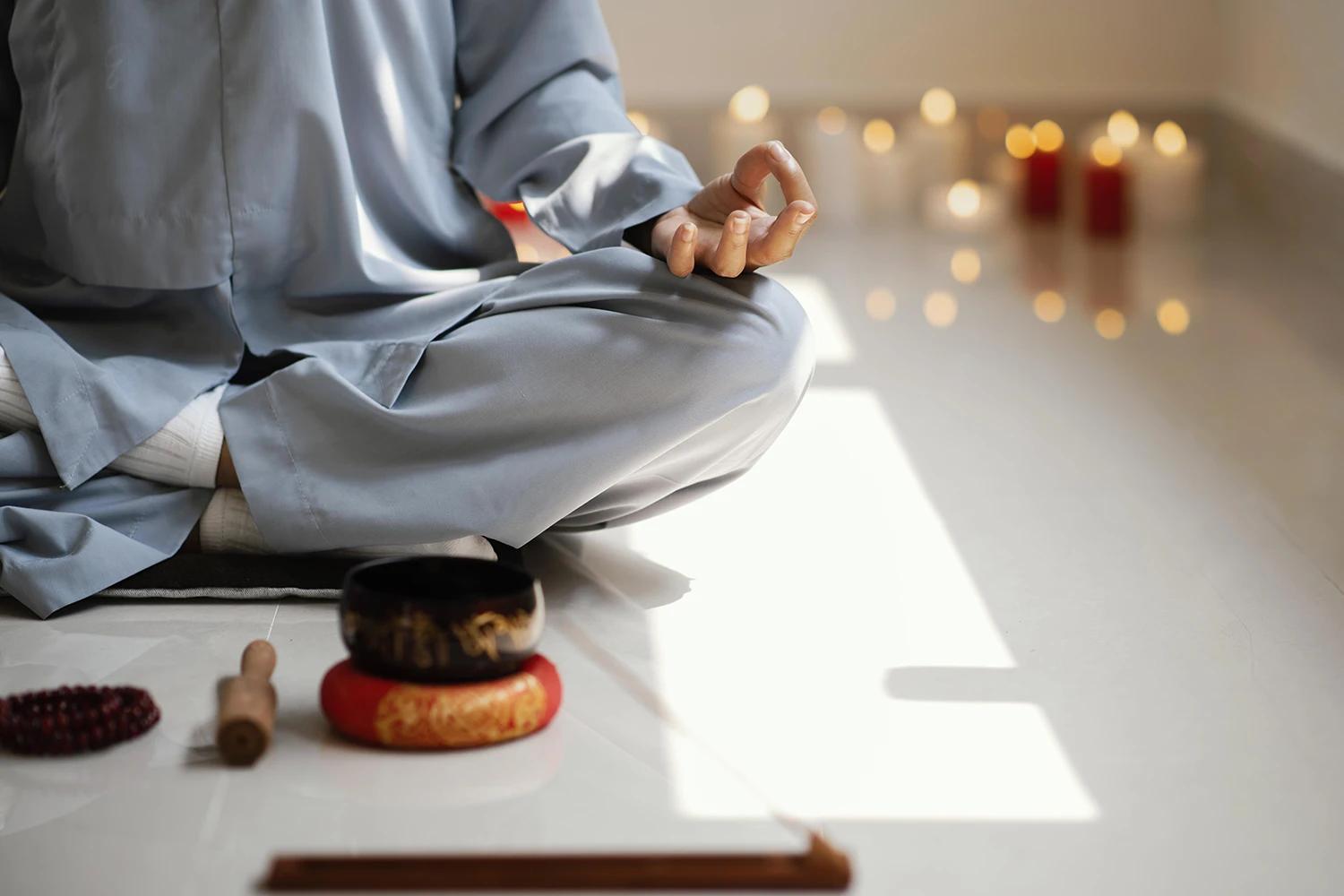
The basic principles of Taoist meditation are rooted in Taoism, a Chinese philosophy that teaches harmony with nature and with the flow of life. Unlike the meditation techniques best known in the West, Taoist meditation does not aim at total control of the mind, but at cultivating vital energy (qi) and discovering inner balance.
1. The basic principle of Taoist meditation
The first principle of Taoist meditation is connection with the Tao, the fundamental principle that pervades the universe. It is not a deity to be worshipped, but a natural flow to align with. To meditate is to observe your own life without forcing, letting actions arise naturally, like the course of a river.
2. Deep relaxation
Body and mind are closely connected: physical tension creates mental agitation. Taoist meditation begins with gradual relaxation, which allows qi to circulate freely. This can happen through seated postures, slow walking or breathing exercises. The aim is not to “empty the mind” but to free it from blockages, accepting thoughts and sensations without judgement.
3. Conscious breathing
Breathing is central to Taoist meditation, often more important than posture or mental concentration. Breathing slowly, deeply and naturally nourishes the body with qi, harmonises the heart rhythm and calms the mind. Some Taoist techniques use the breath to direct energy towards specific vital centres of the body, contributing to physical and emotional wellbeing.
4. Cultivating qi
The concept of qi, or vital energy, is fundamental in Taoism. To meditate is to feel, stimulate and harmonise this energy within the body. Through visualisation, breathing and specific slow movements, practitioners learn to perceive the flow of qi, fostering balance, health and longevity.
5. The basic principle of Wu Wei: the art of effortlessness
A distinctive basic principle of Taoism is wu wei, often translated as “non-action” or “effortless action”. In meditation, this means letting go of mental resistance and allowing the natural flow of life to show itself. The practice is not an exercise in control but in attentive listening and openness, without forcing results or expectations.
6. Connection with nature
Taoist meditation invites us to immerse ourselves in nature and sense the rhythm of the elements: wind, water, earth and fire. By observing natural cycles and contemplating phenomena, practitioners develop greater sensitivity and inner harmony. Nature becomes a mirror of one’s inner state and a silent teacher.
7. Consistency and simplicity
Finally, Taoist meditation teaches simplicity and regularity. No complex rituals are needed: just a few minutes a day devoted to listening to the body, to the breath and to awareness of the present moment. Consistent practice, even if brief, has profound effects over time, fostering mental clarity and lasting wellbeing.
Taoist meditation is not a technique to be learned in a hurry, but a path of personal discovery. Through relaxation, conscious breathing and the harmonisation of qi, practitioners learn to live in tune with themselves and the world around them. It is a practice of listening, acceptance and naturalness, which teaches us to flow with life rather than fight against it.